CE Approved Compact Excavators: Your Handbook to Adherence
CE Approved Compact Excavators: Your Handbook to Adherence
Blog Article
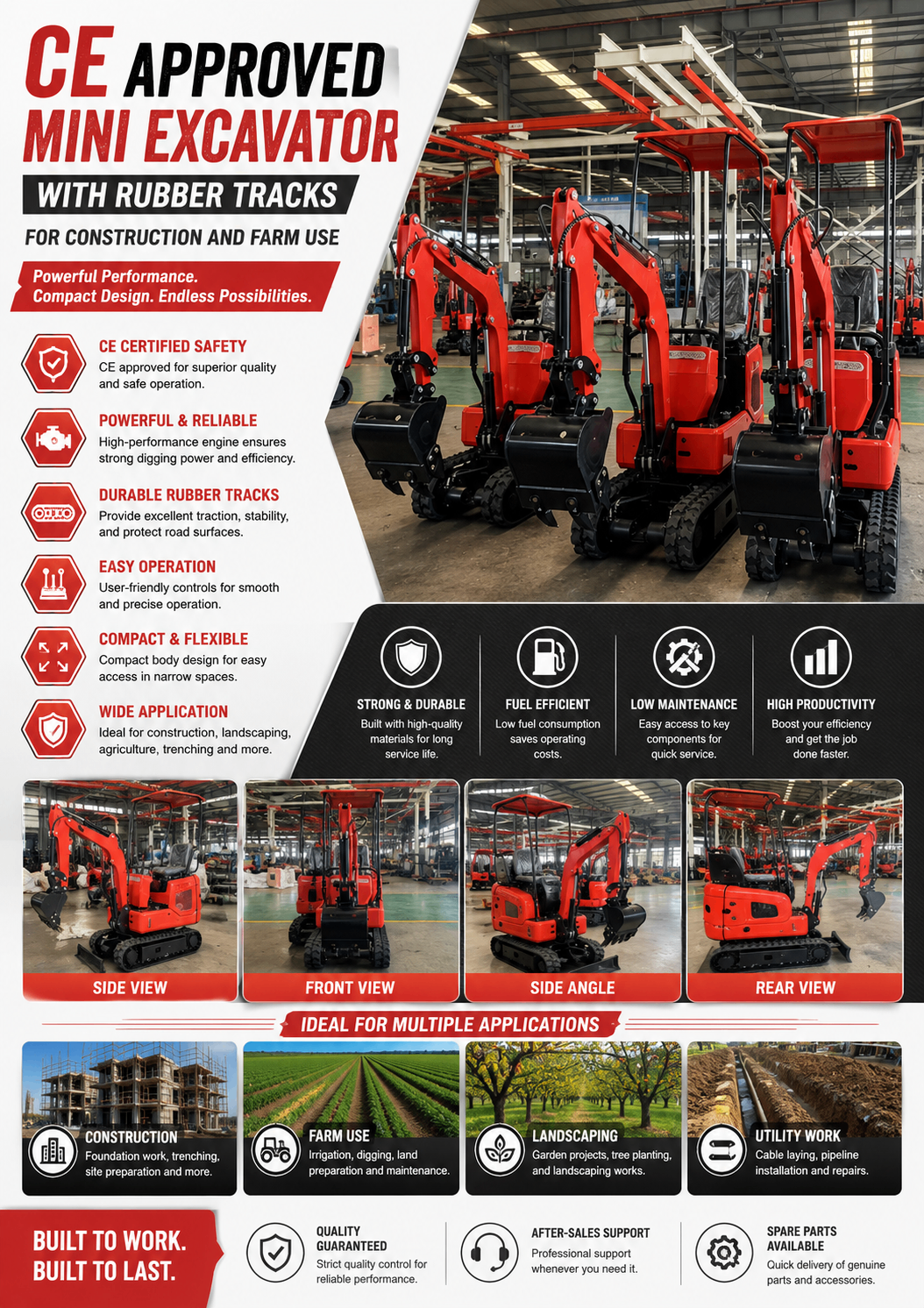
Ensuring your mini machine Compact tracked excavator meets European approval requirements is crucial for market within Europe. Our guide covers the necessary aspects of CE accreditation for small tracked machines, covering regulations related to operator protection, machinery assessment, and documentation. Understanding the specifications enables companies to correctly operate their machinery and circumvent serious fines.
Specialized Track Mini Machines: Outstanding Pull for Challenging Landscape
Mini diggers equipped with composite tracks are transforming how contractors manage projects in demanding situations. Unlike traditional tire-equipped models, these adaptable machines offer exceptional traction on unstable surfaces like mud, ice, and inclined grades. This greater balance allows operators to execute tasks effectively and productively, reducing downtime and increasing productivity. The compliant nature of steel tracks also diminishes ground pressure, protecting delicate surfaces and reducing environmental disturbance.
Compact Diggers: Impressive Capability in Tight Work Areas
These robust miniature excavators provide a notable answer for jobs where conventional equipment cannot maneuver. Their limited footprint permits access to challenging areas, like basement systems or within current buildings. Despite their scale, they boast considerable trenching force and precision, allowing them perfect for a broad scope of construction functions. Ultimately, mini excavators embody a intelligent investment for builders facing the difficulties of confined job-sites.
Compact Machines for Properties: Adaptability and Effectiveness in Crop Operations
Modern agriculture operations often require equipment that can handle a wide range of challenging jobs. Mini excavators are quickly becoming invaluable assets for farmers , offering exceptional flexibility and efficiency across a diverse array of crop operations . From excavating for irrigation networks and water removal to shifting soil for building enclosures or platforms, these devices provide a capable solution. They even excel at clearing land for seeding , leveling land, and managing substances with simplicity . Their compact size allows them to operate in limited spaces that larger vehicles simply cannot reach .
- Digging for Irrigation
- Moving Soil
- Clearing Land for Planting
Picking the Appropriate Mini Digger in Construction vs. Rural Uses
When choosing a mini excavator , it's essential to understand the significant differences between building projects and agricultural operations . Construction sites often require more force, exactness, and the ability to operate in small locations. As a result, a robust model with a wide assortment of tools might be best . In contrast , agricultural land frequently involve minimal digging depths , more landscape shaping, and the necessity for small equipment to navigate fields . Ultimately , thorough assessment of the planned assignments is essential for securing the suitable selection .
- Consider excavation depths .
- Assess the area boundaries.
- Consider the required tools .
- Take into account hauling issues.
{CE Certification & Mini Compact Equipment: What Users Need to Know
Ensuring your {mini excavator is adheres to relevant European directives is crucial, and that's where {CE labeling comes into play . This indicator demonstrates that the device has been assessed and meets safety requirements, allowing free movement within the EU. {For purchasers of these machines, understanding CE labeling is important. It isn't simply about having a sticker on the machine ; it represents a process of manufacturing and performance .
- Verify the presence of the CE label .
- Consult the conformity document – this details the guidelines the machine meets.
- Consider that CE labeling is the supplier's responsibility – even owners must be aware of its significance.